Insight2 min readEnergy and the grid
Data centres and regional land: what is being said, and what is known
Data centres are a fast-growing source of electricity demand. What AEMO has published, and what it means for rural land.
Data centres have become the most talked-about source of new electricity demand. Some of what is said about them is well founded and some runs ahead of the evidence. Here is what the market operator has actually published.
What is known
In June, AEMO reported that Australia has 162 operational data centres, mostly in Sydney and Melbourne, using around 2% of grid-supplied electricity.
Its 2025 Inputs, Assumptions and Scenarios report projected that consumption growing by about 25% a year to roughly 12 terawatt hours by 2030, or about 6% of grid-supplied electricity, and continuing to about 34 terawatt hours, or 12%, by 2050.
AEMO also notes two things about how these facilities behave. Large ones take five to ten years to ramp up to full load. And they tend to run as steady, inflexible loads, because their customers pay for uptime.
What is less certain
The pipeline of announced projects is much larger than the forecast. Not every proposal will be built, and those that are will not all reach full size. AEMO builds that caution into its outlook, and so should anyone else.
The forecasts have also moved a long way in a short time. The operator has said that development has outrun its earlier expectations. Numbers that have been revised up sharply can be revised again, in either direction.
Where the land comes in
It is worth being precise here, because the link between data centres and rural land is often overstated.
Most data centres are in or near capital cities, close to customers, fibre and skilled staff. They are not, for the most part, being built on farms.
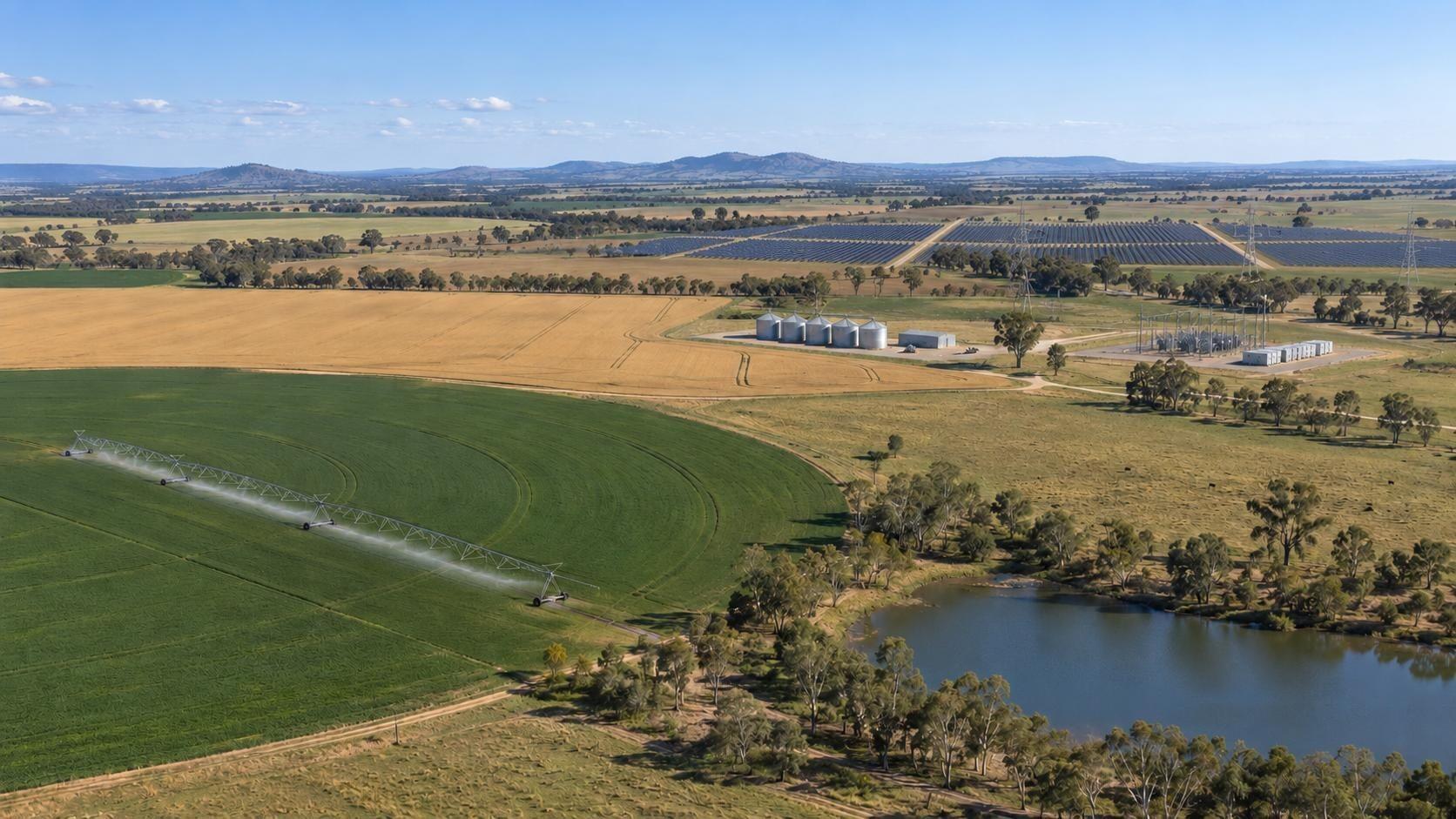
The connection to regional land is mainly indirect. A steady new load in the cities has to be supplied, and the generation, storage and transmission that supply it are built largely in the regions. More data centre demand means more of that infrastructure, sooner.
There is a smaller, direct connection too. Some developers are looking at regional sites where power and land are available together, beside strong network or new generation. That is a real trend, but an early one, and each proposal needs to be judged on its particulars.
What we take from it
We hold two views at once.
Data centre demand is real, it is growing, and the operator now treats it as a core part of system planning. It adds to the case that the electricity system will be larger and that more of it will be built in regional Australia.
Equally, it is one driver among several, and the most speculative end of the discussion should be treated as speculation. Land does not become valuable because someone has mentioned data centres near it.
For landowners the sensible position is the same as for any other energy-related use. Understand what a site would actually need: network capacity, water, access, planning. Be sceptical of approaches that are long on excitement and short on detail. And keep the farm sound in the meantime, because that is what the land is doing today.
Sources
© InfraAg Management Pty Ltd ACN 679 804 061. The information on this website is general in nature and is not an offer of securities or financial product advice. See Disclaimer.
Insight
Transmission: why the grid has to go through farming country
AEMO's 2026 plan calls for about 6,000 km of new transmission by 2050. Why it is needed, and why it runs across farmland.
ReadInsight
Where Australia's electricity demand is heading, in plain terms
AEMO's 2026 Integrated System Plan expects electricity use to roughly double by 2050. A short guide to what is driving it.
Read